Growth Intelligence takes the scans your sonographers already do and gives every pregnancy in your practice a projected weight at delivery, a flag if it needs a second look, and a plain statement of how much can be known at that point in the pregnancy.
Internal validation, 814 pregnancies, August 2026.

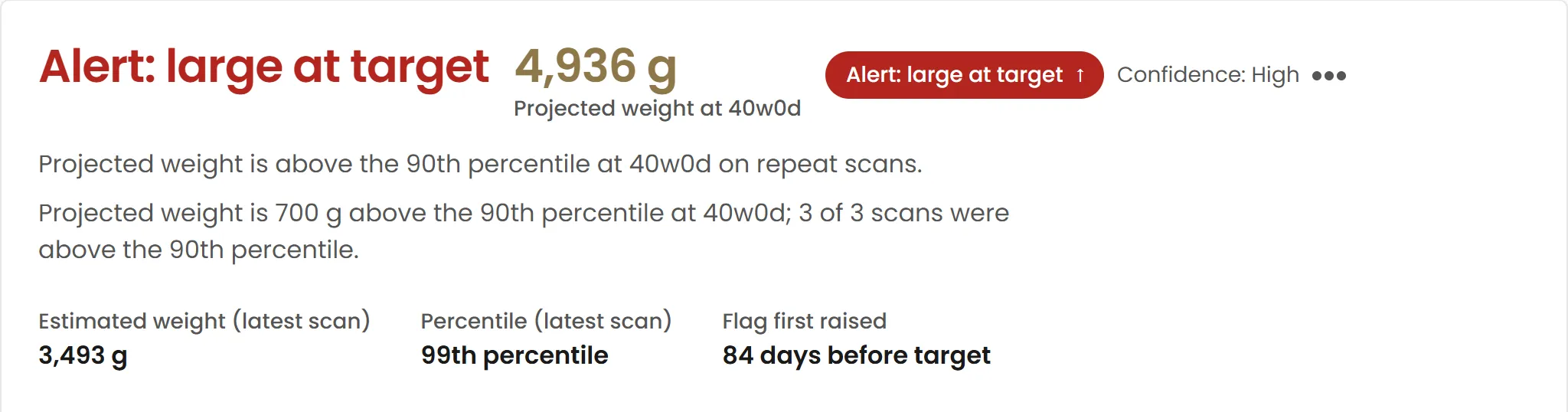
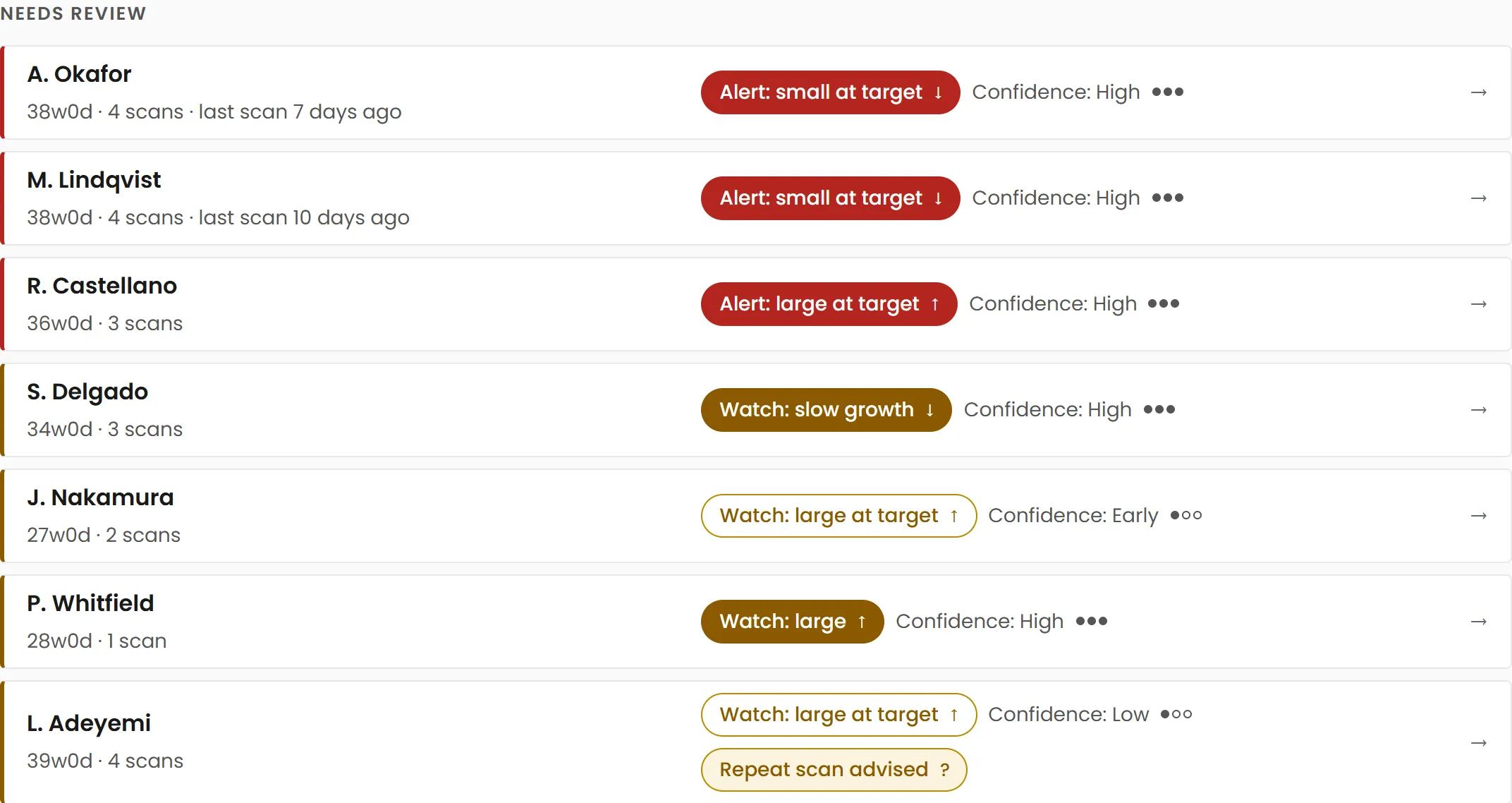
The worklist ranks every active pregnancy by its latest scan. Each flag says what it found and how far to trust it.

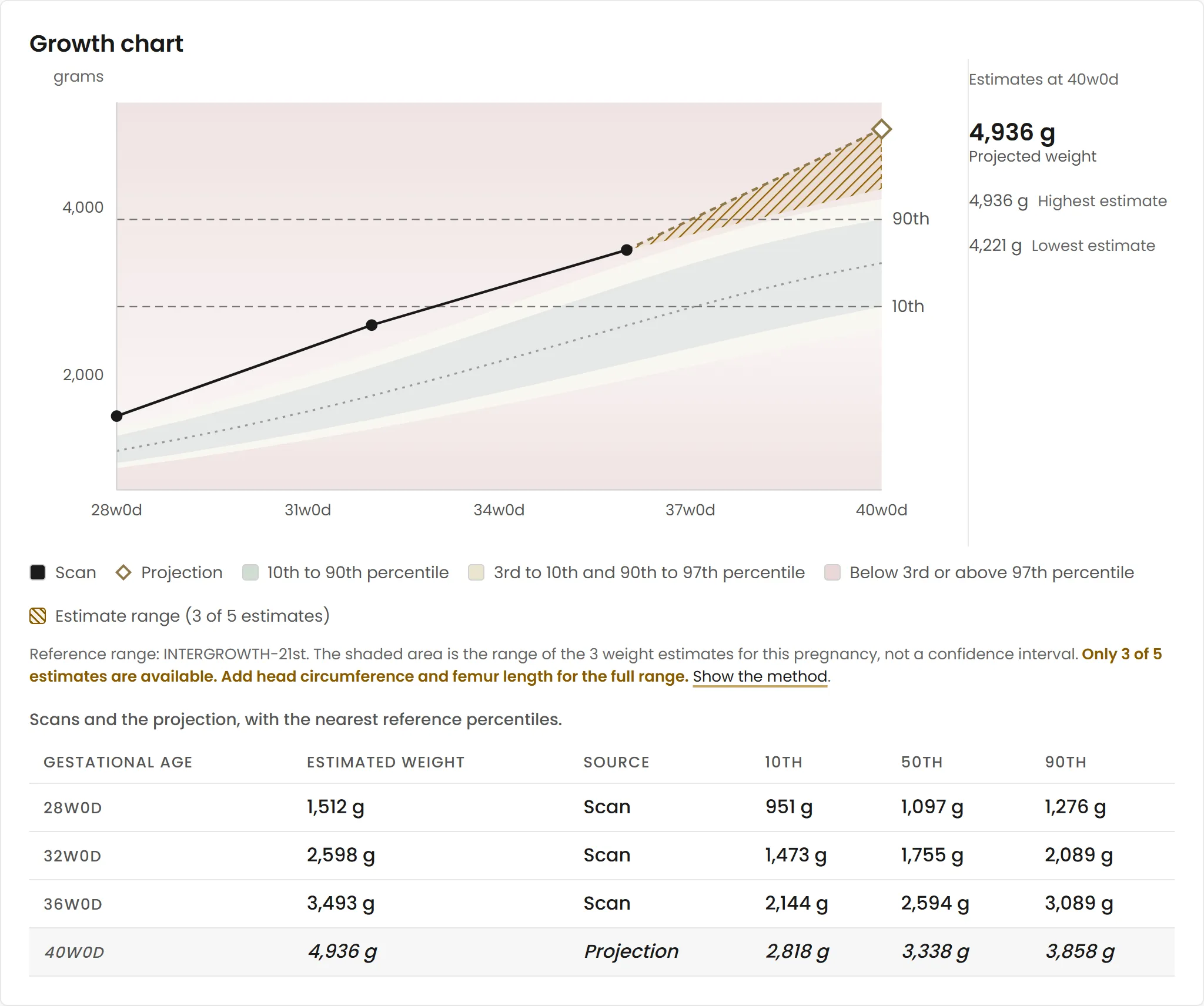
Every scan is placed on the INTERGROWTH-21st reference, with the projected weight at term and the range around it.

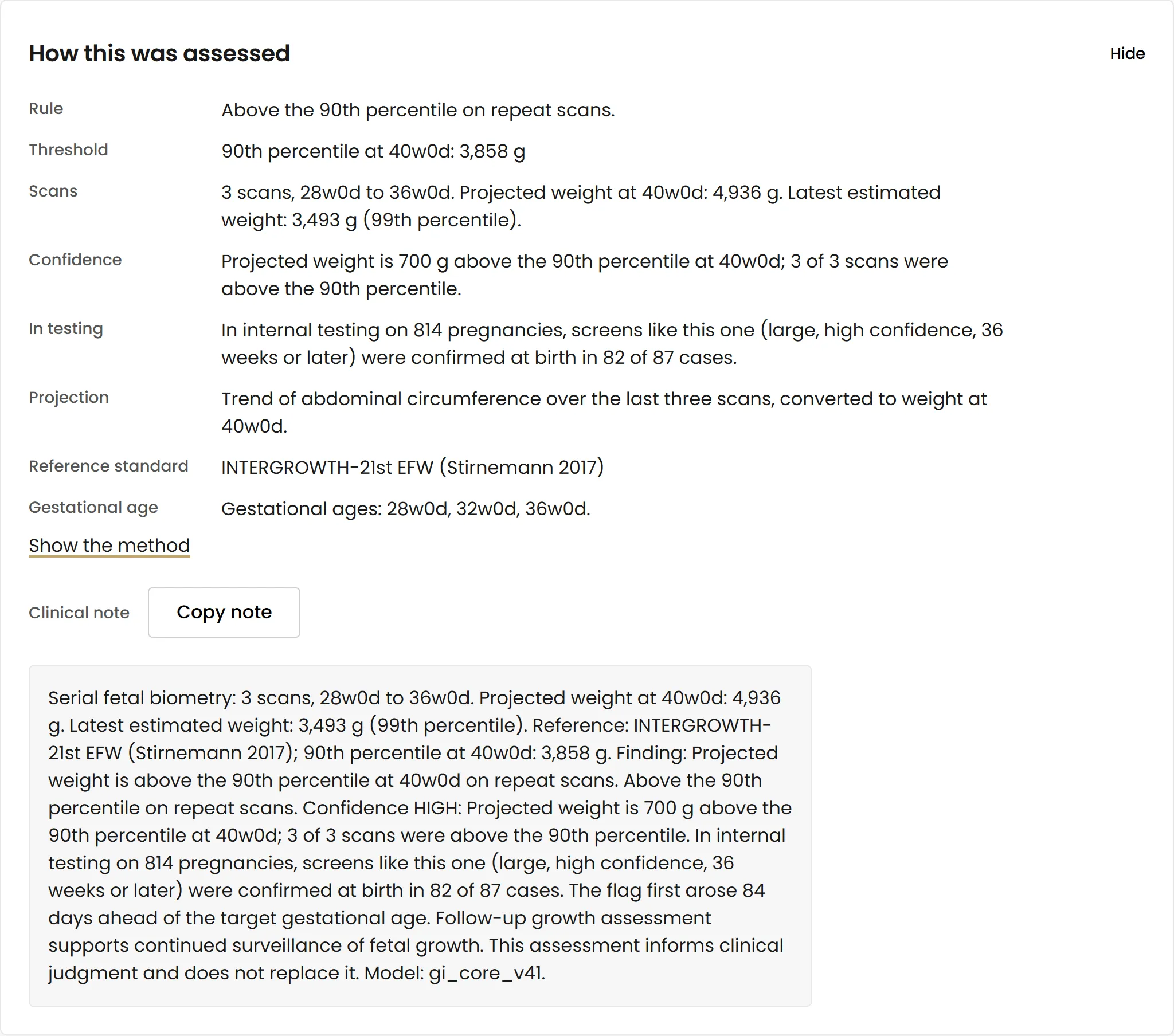
Because it shows its work: the rule it crossed, the threshold, the scans it used, and how often that kind of flag was confirmed at birth. The clinical note is already written. Copy it.

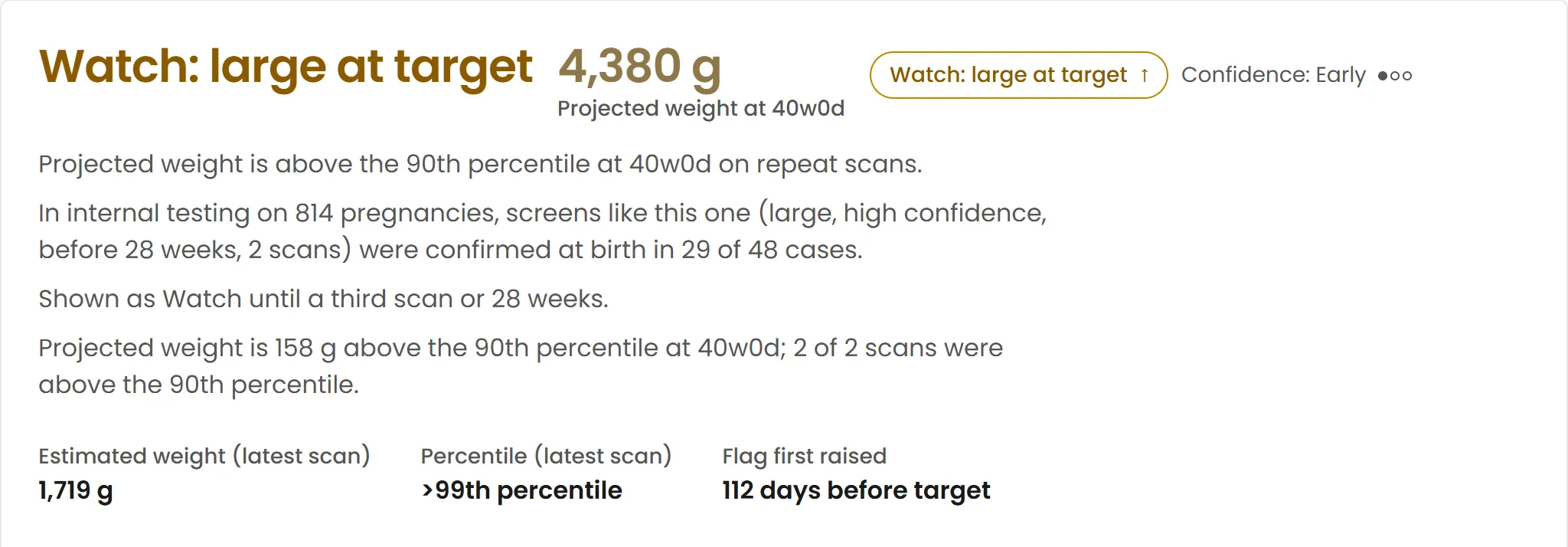
Two scans at 27 weeks is a signal. Four scans at 34 weeks is a finding. In validation, the first kind was confirmed at birth in 29 of 48 cases; the second in 66 of 69.²
Growth Intelligence knows the difference and shows it. The early flag is a Watch, with its own confirmation rate on the screen and what would raise it: a third scan, or 28 weeks. It becomes an Alert when the evidence supports one. Not before.

The estimated fetal weight decides who gets watched, who gets induced, and who gets a cesarean.³ It is least reliable at the extremes, where those decisions get made.
ACOG's own bulletin puts ultrasound sensitivity for a baby over 4,500 g at 10 to 45 percent, no better than a hand on the abdomen.⁴ One in four fetuses estimated at the 20th percentile is actually below the 10th.⁵
Estimated fetal weight is frequently the most important factor guiding clinical decisions during pregnancy—including heightened surveillance, induction of labor, and cesarean delivery (Kadji et al., Am J Obstet Gynecol 2022). Below the 10th percentile for gestational age, a fetus is classified small for gestational age and enters a surveillance pathway—Doppler studies, serial ultrasound, early delivery planning (American College of Obstetricians and Gynecologists [ACOG] Practice Bulletin 227, 2021). Above 4,500 grams, it triggers counseling for cesarean delivery to avoid shoulder dystocia (ACOG Practice Bulletin 216, 2020).*
*For diabetic pregnancies, this threshold is 4,000 grams.
The formula used in the vast majority of clinical settings was derived from 167 patients at a single hospital in 1984 (Hadlock et al., 1984). No general-purpose formula developed since has outperformed it on aggregate metrics (Hammami et al., Ultrasound Obstet Gynecol, 2018)—but aggregate performance conceals the problem at the clinical margins, where decisions carry the highest stakes.
The result is a detection gap that is widest exactly where it matters. ACOG reports that sensitivity for detecting birth weight above 4,500 grams ranges from 10 to 45 percent (ACOG Practice Bulletin 216, 2020). Approximately half of all fetal growth restriction cases go undetected, even in high-income countries (McCowan et al., 2018).
One analytic study found that systematic error in the current formula means roughly one in four fetuses estimated at the 20th percentile is actually below the 10th—the threshold for enhanced monitoring (Lappen & Myers, Am J Obstet Gynecol, 2017).
"For suspected macrosomia, the accuracy of estimated fetal weight
using ultrasound biometry is no better than that obtained with abdominal palpation."
-ACOG Practice Bulletin 216, 2020
A de-identified spreadsheet of past pregnancies. Abdominal circumference, gestational age at each scan, gestational age at delivery, and birth weight are all we need. Head circumference, biparietal diameter, and femur length are optional and improve the estimates. A formatting guide and a template are on the retrospective page.
Every pregnancy is assessed scan by scan, as it would have been at the time, and scored against the recorded birth weight.
A written report on your population: what would have been flagged, how many weeks before delivery, and how that compares with the method you use today, on the same cases.
In 2024 the American Law Institute rewrote the standard for medical negligence. The question is no longer what is customary. It is what is reasonable.⁶ In Raposo v. United States (2025), a federal court held that reasonable care means accounting for a 20 percent margin of error in estimated fetal weight, and that professional guidelines do not set the ceiling.⁷
In May 2024, the American Law Institute approved its first-ever Restatement (Third) of Torts: Medical Malpractice, shifting the standard of care from strict reliance on prevailing custom toward evidence-based evaluation of reasonable care (summarized in Aaron et al., JAMA, 2025). Compliance with prevailing custom remains relevant, but is no longer necessarily decisive.
Courts have held that an entire profession's failure to adopt available technology does not insulate individual practitioners from liability. The principle was first applied to medicine in Helling v. Carey (Wash. 1974): physicians were held liable for failing to administer a simple, available diagnostic test—though professional custom did not require it—because the test was inexpensive, harmless, and could have prevented serious injury. In 2024, the ALI's Restatement adopted a framework consistent with this reasoning at the national level.
Fetal weight misestimation has produced verdicts reaching tens of millions of dollars. In Manning v. Pecos Valley of New Mexico (2018), a $73 million verdict involved underestimation of fetal weight where the defense's own experts described the care as "indefensible." In Swanson v. Northern Westchester Hospital Center (N.Y. 2009), a brachial plexus injury from shoulder dystocia produced an award of $56 million at trial.
In 2025, a federal district court held that the standard of care requires clinicians to account for a 20 percent margin of error in estimated fetal weight—while holding that professional guidelines do not set the ceiling for reasonable care (Raposo v. United States, D. Alaska 2025). Applying that margin to a 4,200-gram estimate yielded approximately 5,040 grams, crossing the threshold at which cesarean delivery should be considered; the court evaluated each provider's conduct against the estimate available at the time.
Other published verdicts include Zhao v. United States (S.D. Ill. 2019, $8.3M), Rodriguez v. Yale-New Haven Health (Conn. 2023, $6.5M), and Klutschkowski v. PeaceHealth (Ore. 2011, $1.9M).
1. Validation cohort of 814 pregnancies with recorded birth outcomes, assessed against the INTERGROWTH-21st standard. The cohort is enriched for growth abnormality (14 percent small and 31 percent large for gestational age at birth), so confirmation rates run higher than in a general population. Growth restriction detected: 92 of 117. Macrosomia detected: 206 of 254. Data on file, August 2026.
2. Screens assessed as they would have appeared at each scan, 3,809 in total, scored against birth weight. Alert screens under the display rule, both tails: 235 of 249 confirmed (small for gestational age 48 of 52, large for gestational age 187 of 197). Data on file, September 2026.
3. Kadji et al., Am J Obstet Gynecol 2022.
4. ACOG Practice Bulletin 216, 2020.
5. Lappen & Myers, Am J Obstet Gynecol 2017.
6. Restatement (Third) of Torts: Medical Malpractice, American Law Institute, May 2024; summarized in Aaron et al., JAMA 2025.
7. Raposo v. United States, D. Alaska 2025.
Not an FDA-cleared device. Clinical decision support under the CDS exemption.